

Top 10 Best Accounting Software for UK SMEs: A Guide to Smarter Accounting

Choosing the right accounting software is one of the more consequential decisions a small or medium-sized business makes, and it has become more consequential still with the arrival of Making Tax Digital for Income Tax. The right platform saves time, reduces error, keeps the business compliant, and turns the finance function from a chore into a source of genuine insight. This guide sets out the ten accounting platforms most worth considering for a UK SME, the criteria that actually matter when choosing between them, and the one regulatory change that should now sit at the centre of the decision.
Start here: Making Tax Digital for Income Tax
Before comparing features, understand the deadline that now shapes the whole choice. Making Tax Digital for Income Tax Self Assessment (MTD for ITSA) begins on 6 April 2026. From that date, self-employed people and landlords with qualifying income above £50,000 must keep digital records and submit quarterly updates to HMRC using compatible software — and the threshold is scheduled to drop to £30,000 from April 2027, bringing hundreds of thousands more businesses into scope. This is not optional, and a spreadsheet on its own will not meet the requirement, because HMRC requires digital links rather than manual copying between records and return.
The practical consequence for choosing software is simple but important: MTD compatibility is now the first filter, not a nice-to-have. Before you weigh up price or features, confirm that any platform you are considering is on HMRC’s list of compatible software. Most of the established paid platforms — Xero, QuickBooks, Sage, FreeAgent, Zoho Books, KashFlow — are MTD-ready. Some of the free tools are not, which matters a great deal if you are over the threshold. I have flagged this against each platform below, because getting it wrong is the one mistake in this decision that carries a legal penalty.

How to choose: the criteria that matter
Beyond MTD compatibility, a handful of criteria separate the right platform from the wrong one for your business. Usability comes first — the software will be used daily, often by people without an accounting background, so an intuitive interface and a manageable learning curve matter more than a long feature list. The core features are non-negotiable: invoicing, expense tracking, bank reconciliation, VAT handling and financial reporting, with payroll either built in or cleanly integrated. Beyond that, consider how well the platform scales as you grow, how it integrates with the other tools you use (your bank, your e-commerce platform, your CRM), the strength of its security, the quality of its support, and of course the total cost — not just the headline price but the tier you will actually need.
A sensible approach is to shortlist two or three platforms that clear the MTD and core-feature bar, then use their free trials to test them against your real workflow before committing. The best software on paper is not always the best fit for how your business actually works, and an afternoon spent trialling saves months of regretting the wrong choice.

The top 10 accounting software platforms for UK SMEs
1. Xero
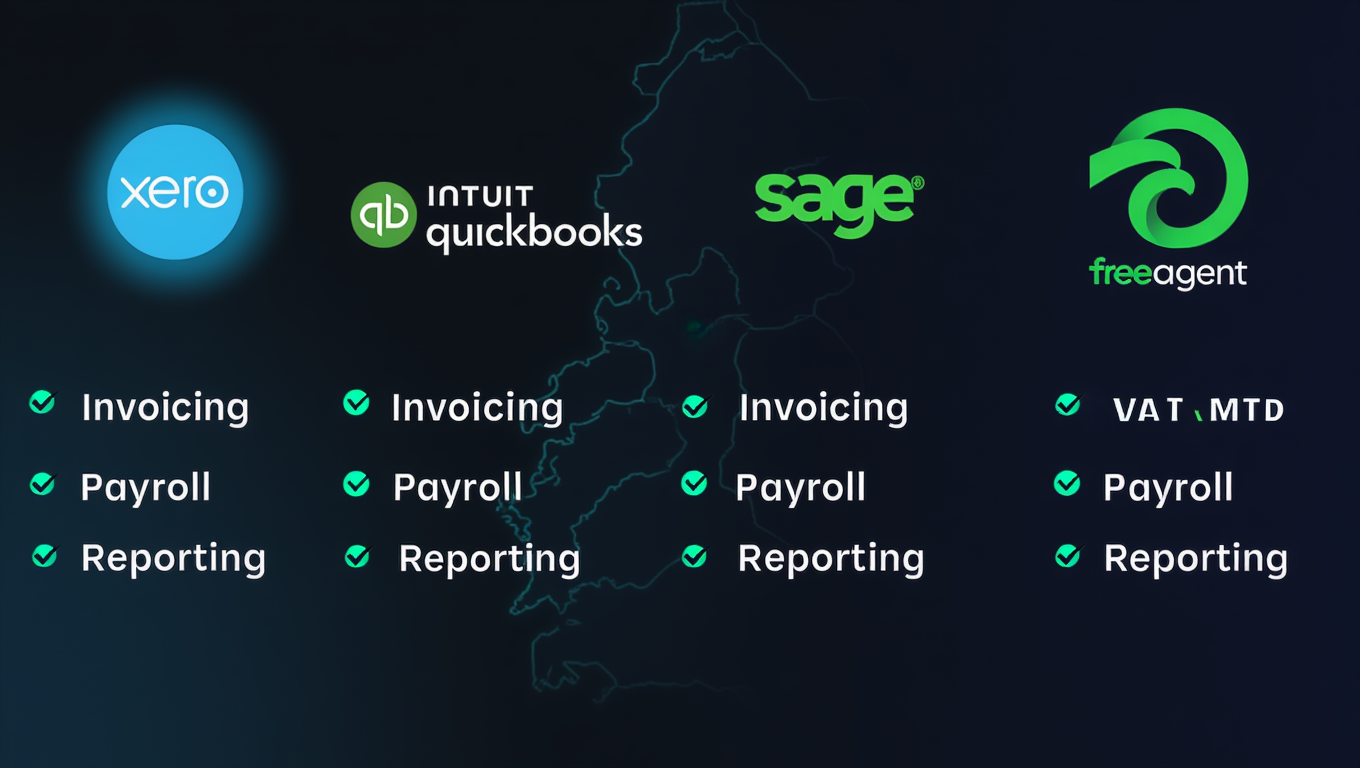
Xero has become one of the default choices for UK small businesses and the accountants who serve them, and for good reason: a clean, genuinely easy-to-use interface, strong bank reconciliation, an enormous ecosystem of integrations, and full MTD compatibility. It suits growing businesses that want room to scale, and its ubiquity among UK accounting practices makes collaboration straightforward. Pricing is subscription-based across tiers; it is not the cheapest, but it is among the most capable and best-supported.
2. QuickBooks Online
QuickBooks Online is Xero’s closest rival and an equally safe choice — comprehensive core accounting, strong invoicing and reporting, wide integrations, and full MTD support. It tends to appeal to sole traders and small businesses wanting a well-rounded, widely-recognised platform, and its tiered pricing scales from very small operations upward. Between Xero and QuickBooks the honest answer is that both are excellent; the decision often comes down to which interface you prefer and which your accountant uses.
3. Sage Business Cloud Accounting
Sage is the long-established UK name, and its cloud accounting product carries that heritage of solid, compliance-focused functionality. It is MTD-ready, strong on the reporting and controls that larger or more complex SMEs value, and backed by extensive support. For a business that wants an established, UK-rooted provider — particularly one growing towards more sophisticated requirements — Sage is a dependable choice.
4. FreeAgent
FreeAgent is well suited to freelancers, contractors and small businesses, with a friendly interface and strong handling of self-assessment and the day-to-day essentials. It is MTD-compatible, and notably it is free to NatWest, Royal Bank of Scotland and Ulster Bank business account holders — which makes it genuinely zero-cost for a large number of UK businesses. For a sole trader banking with any of those, FreeAgent is one of the first options to look at.
5. Zoho Books
Zoho Books offers a lot of capability for the price and fits naturally into the wider Zoho ecosystem if you already use its CRM or other tools. It is MTD-compatible, strong on automation and invoicing, and competitively priced, with a free tier for the smallest businesses (subject to revenue limits). For a business that values integration across a suite of tools, or wants strong functionality at a keen price, it is well worth a look.
6. KashFlow
KashFlow (now part of IRIS) is a UK-focused platform aimed squarely at small businesses, sole traders and contractors, covering accounting, bookkeeping and payroll with MTD compatibility built in. Its long UK track record and integration with the wider IRIS ecosystem make it a solid, compliance-ready option for a UK small business that wants a home-grown platform.
7. FreshBooks
FreshBooks is built around invoicing and is particularly strong for service businesses, freelancers and contractors who bill clients and want that process to be effortless. The interface is clean and the time-tracking and invoicing tools are excellent. UK businesses should confirm current MTD arrangements for their specific needs before committing, since FreshBooks is stronger on the invoicing side than on full UK tax submission — check it against your compliance requirements first.
8. Clear Books
Clear Books is a UK-based platform offering straightforward, MTD-compatible accounting aimed at small businesses and sole traders. It covers the essentials cleanly — invoicing, expenses, VAT, reporting — without unnecessary complexity, and its UK focus means it is built around UK compliance. A sensible option for a small business wanting simplicity and home-market alignment.
9. Crunch
Crunch is a slightly different proposition: a combination of software and accounting service, popular with freelancers, contractors and small limited companies who want software backed by access to real accountants. For a business that wants more hand-holding than pure software provides — particularly contractors navigating their own tax — the hybrid model is appealing, and it is built for UK compliance.
10. Wave — with an important caveat
Wave deserves inclusion because it remains one of the very few genuinely free accounting platforms — unlimited invoicing, expense tracking and basic reporting at no monthly cost, which is attractive for the smallest micro-businesses and side-hustles. But the caveat is critical for a UK audience in 2026: Wave does not support UK Making Tax Digital submissions and does not offer UK payroll. If your income is below the MTD threshold and you simply need free bookkeeping, it can work as a starting point — but if you are over the £50,000 threshold, or expect to be, you will need MTD-compatible software or a bridging tool alongside it, and you may be better starting with one of the free or low-cost MTD-ready options above. Include Wave with your eyes open, not as a compliance solution.
Comparing the options in practice
Across these ten, a few patterns help you narrow down. For most growing SMEs that want a capable, widely-supported, MTD-ready platform and are willing to pay for it, Xero and QuickBooks Online are the two safe defaults, with Sage a strong third for those wanting an established UK name. For freelancers and contractors, FreeAgent (free with the right bank), FreshBooks and Crunch are built around your needs. For the cost-conscious, Zoho Books and the free FreeAgent route offer genuine capability without a heavy subscription, while Wave serves the smallest micro-businesses provided the MTD limitation is understood. KashFlow and Clear Books round out the UK-focused, compliance-ready options.
The single most useful thing you can do is shortlist against the two filters that matter most for your situation — MTD compatibility if you are over the threshold, and fit with how your business actually operates — then trial the shortlist. Almost all of these offer free trials or demos, and the right choice becomes obvious surprisingly quickly once you are working in the software rather than reading about it.
Software is the tool, not the strategy
A final point worth making, because it is easy to lose in a software comparison: the platform is only as valuable as the use made of it. Good accounting software gives a business clean, timely, reliable financial data — but data is not insight, and a business grows on the strength of the decisions made from that data, not the software that produced it. The right platform makes the numbers available; it takes financial judgement to turn them into better pricing, tighter cost control, and sound investment decisions.
For a growing business, the step-change usually comes not from upgrading the software but from bringing in the finance leadership to interpret what it shows and act on it — a fractional or part-time CFO or finance director who turns clean data into commercial decisions. FD Capital’s CFO recruitment team places these leaders into growing UK businesses, permanent and interim.
Call 020 3287 9501 or email recruitment@fdcapital.co.uk to discuss the finance leadership that turns good financial data into better business decisions.
FD Capital — CFO & Finance Director Recruitment
Fellow of the ICAEW | Placing CFOs and finance directors who turn financial data into commercial results for growing UK businesses since 2018. 4,600+ network. 160+ placements. Shortlists in 3–7 working days.
Looking to hire? FD Capital’s CFO recruitment service
FD Capital provides specialist CFO recruitment for UK businesses. Explore our CFO recruitment service or call 020 3287 9501 to discuss a mandate.
Related reading and services
Choosing finance systems at the next level up.
Using clean financial data to control cost.
Part-time CFO leadership for growing businesses.
Permanent, interim and fractional CFO appointments.
About the author
Adrian Lawrence FCA is the founder and Managing Director of FD Capital. A Fellow of the Institute of Chartered Accountants in England and Wales and a former listed-company Finance Director, he leads every finance-leadership mandate FD Capital accepts personally. Verify his ICAEW membership.
Call 020 3287 9501 or email recruitment@fdcapital.co.uk.
This article is general information and does not constitute professional advice.
Related posts:
Understanding Variable Costs: A Beginner's Guide to Business Budgeting
October 21, 2024Understanding the Average Equity for UK Startup Employees: A Comprehensive Guide
October 21, 2024Sector-Specific Financial Strategies: Leveraging Industry Expertise for Scalable Business Growth
January 19, 2025Cash Versus Profit The Gap That Breaks Many Scale-Ups
December 29, 2025Building a Single Source of Truth in Modern Finance
January 1, 2026Why Agile Finance Teams Outperform in Volatile Markets
August 13, 2025
Adrian Lawrence FCA is the founder of FD Capital and a Fellow of the Institute of Chartered Accountants in England and Wales (ICAEW). He holds a BSc from Queen Mary College, University of London, and has over 25 years of experience as a Chartered Accountant and finance leader working with private, PE-backed and owner-managed businesses across the UK. He founded FD Capital to connect growing businesses with the Finance Directors and CFOs they need to scale — and personally interviews candidates for senior finance appointments.



 Accredited Member of GBC
 Accredited Member of LWF
 Carbon Offset via TreeNation