


VCT Investment Guide: UK Venture Capital Trusts Explained
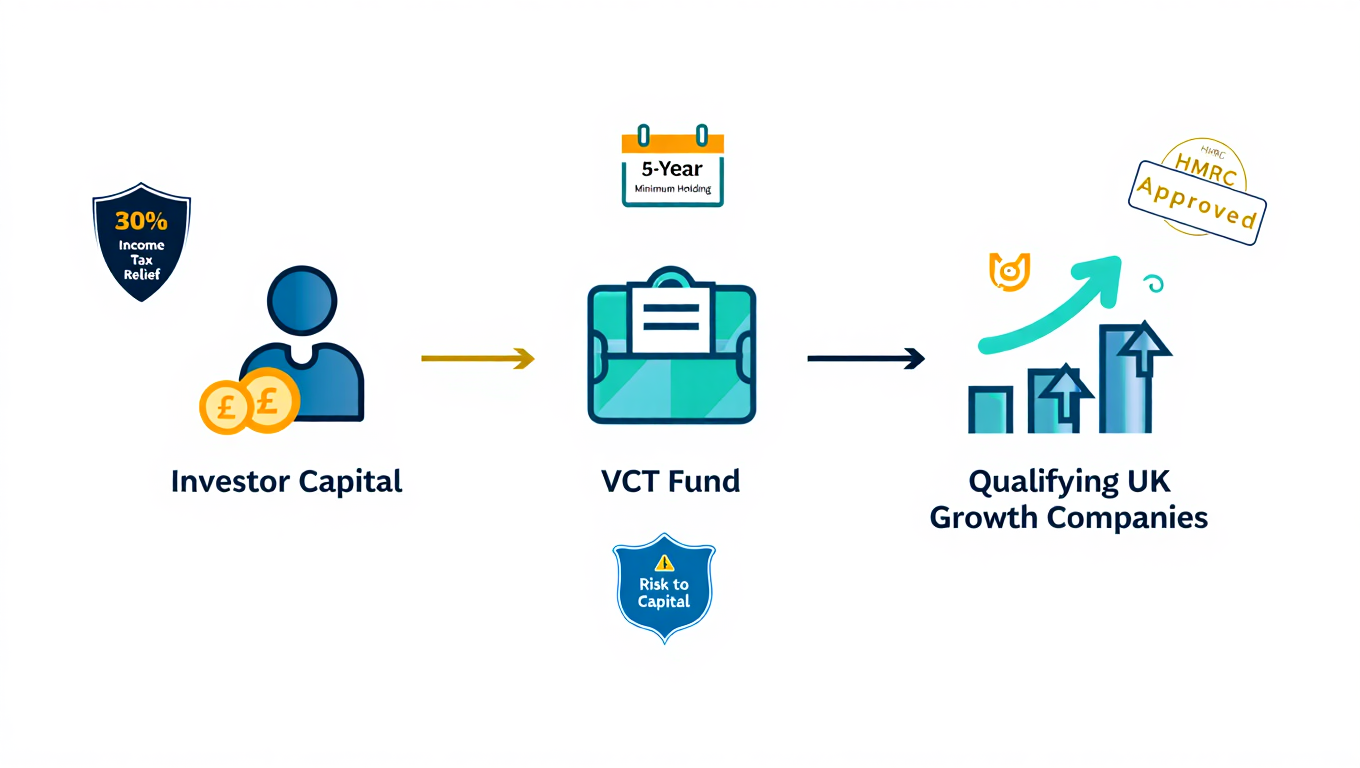
Venture Capital Trusts (VCTs) are listed investment companies that pool investor capital to invest in small, high-growth UK businesses. They were introduced by the UK government in 1995 as a tax-advantaged way to channel investment into early-stage trading companies, alongside the related EIS (Enterprise Investment Scheme) and SEIS (Seed Enterprise Investment Scheme) frameworks. VCTs offer UK-resident investors a combination of 30% income tax relief on the amount subscribed (up to £200,000 per tax year), tax-free dividends, and tax-free capital gains on disposal — subject to specific holding periods and qualifying conditions. VCTs remain a popular tax-advantaged investment vehicle for UK investors seeking exposure to early-stage growth companies, with strict rules governed by HMRC.
This guide explains how VCTs work, the rules investors and businesses need to understand, and the strategic considerations for founders deciding between VCT-approved funding and alternative routes including EIS. For CFOs and FDs advising on capital structure, VCT familiarity is essential — VCT-eligible investment forms a material share of UK growth-stage capital and the rules governing VCT qualifying investment shape the structures commonly used.
How VCTs Work
A VCT is a specific type of investment company, listed on the London Stock Exchange, approved by HMRC under Part 6 of the Income Tax Act 2007. VCTs raise capital from individual UK investors through new share issues and then invest that capital in qualifying UK trading companies on terms that meet HMRC’s qualifying investment criteria.
The VCT structure provides three tax benefits to investors who subscribe for new shares:
1. Income tax relief at 30% on amounts subscribed for new VCT shares, up to an annual investment limit of £200,000 per tax year. To retain the relief, the investor must hold the shares for at least five years. If shares are sold or cancelled before the five-year holding period, the income tax relief is typically clawed back.
2. Tax-free dividends on ordinary VCT shares. Dividends paid by VCTs on qualifying shares are exempt from income tax, without any annual limit on the amount received tax-free.
3. Tax-free capital gains on disposal of VCT shares. Gains made when VCT shares are sold are exempt from UK Capital Gains Tax, making VCTs distinctive among UK tax-advantaged investments.
These tax advantages are subject to specific qualifying conditions and holding periods, as detailed in official HMRC guidance.
VCTs are managed by professional fund management firms — major UK VCT managers include Octopus Investments (the largest VCT manager), Albion Capital, British Smaller Companies Capital, Foresight, Pembroke VCT, and Puma Investments. Fund managers charge annual management fees and performance-related fees, both of which reduce net returns to investors.
VCT Qualifying Investment Rules
For a VCT to retain HMRC approval and provide tax advantages to its investors, it must comply with specific rules on the investments it makes. Understanding these rules matters for both investors (to assess the fund manager’s positioning) and for businesses seeking VCT investment (to confirm eligibility).
70% qualifying holdings requirement
At least 70% of the VCT’s total investment value must be in qualifying holdings — shares or securities in qualifying trading companies meeting HMRC criteria. The VCT has three years from each new capital raise to achieve this threshold with that specific capital.
80% ordinary shares requirement
At least 80% of the VCT’s qualifying holdings must be in ordinary shares, as opposed to preference shares or other share classes with limited upside participation.
Qualifying company criteria
To be a qualifying company for VCT investment, a business must meet several specific tests at the time of investment:
Gross assets limit: £15 million before investment, £16 million after investment. This excludes very large businesses from VCT-eligible funding.
Employee limit: Fewer than 250 full-time equivalent employees (or 500 for “knowledge-intensive” companies).
Age limit: Typically within seven years of first commercial sale (or ten years for knowledge-intensive companies). The rules restricting older businesses from VCT eligibility were tightened in 2015 to focus VCT investment on genuinely early-stage growth companies.
Trading company requirement: The company must be conducting a qualifying trade. Certain activities are excluded (land dealing, financial services, fishery, coal production, receipt of royalties, hotel operation in certain circumstances, and others listed in the legislation).
Risk to capital condition: The investment must satisfy a specific “risk to capital” test introduced in 2018, requiring that the investment is genuinely at risk and the business has ambitions for growth rather than being structured purely for tax-advantaged capital preservation.
Money raised limits: Total VCT, EIS, and SEIS investment must not exceed £12 million (or £20 million for knowledge-intensive companies) in total over the company’s lifetime, with annual raise limits of £5 million (or £10 million for knowledge-intensive companies).
Use of investment proceeds
VCT investment proceeds must be used for the growth and development of a qualifying trade within specific time limits. Proceeds cannot be used to refinance existing debt, distribute to shareholders, or acquire assets that don’t support trade growth.
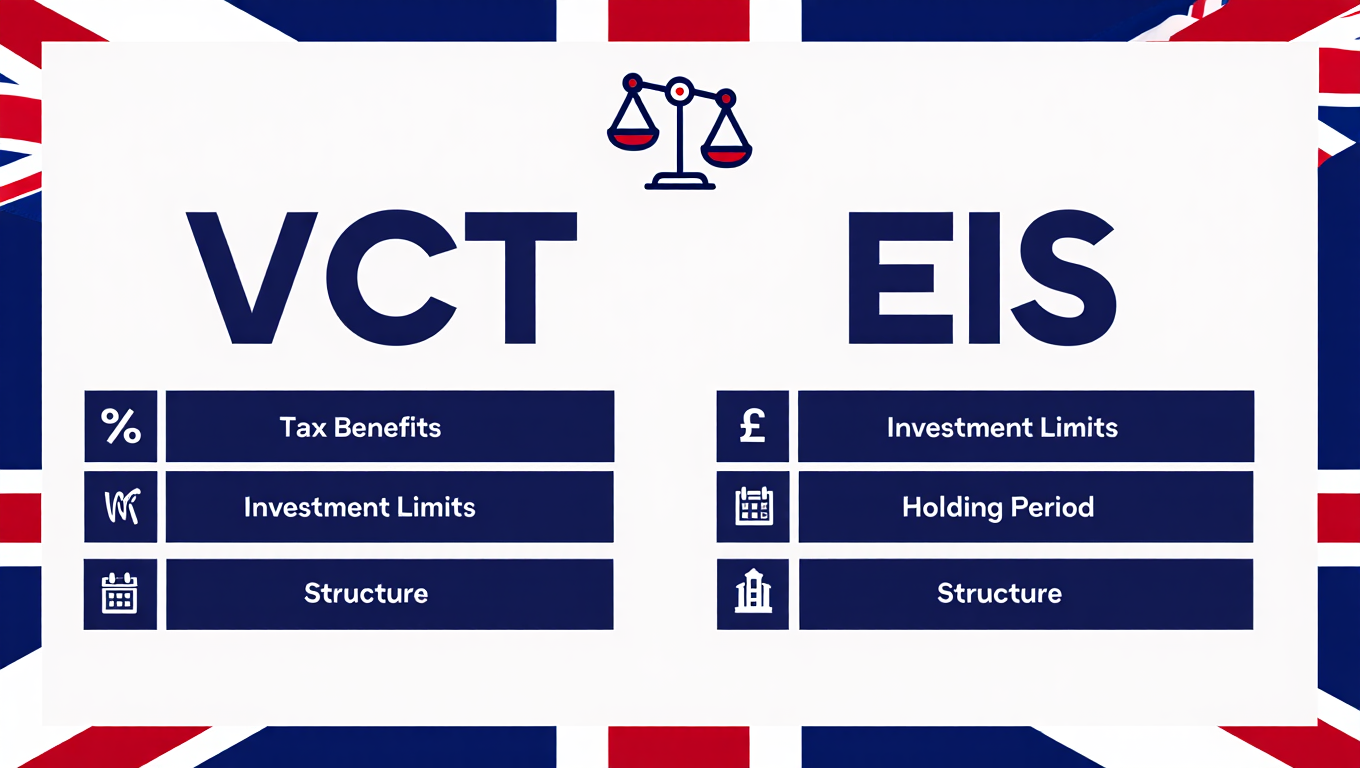 VCT vs EIS: Key Differences
VCTs and EIS (Enterprise Investment Scheme) both offer UK tax relief for investment in small growth companies but operate through different structures with different characteristics. CFOs advising founders on fundraising options often need to compare these routes.
| Feature | VCT | EIS |
|---|---|---|
| Structure | Listed investment company (fund) | Direct investment in single company |
| Income tax relief | 30% on subscription | 30% on subscription |
| Annual investment limit | £200,000 | £1 million (£2 million if at least £1m in knowledge-intensive) |
| Minimum holding period | 5 years | 3 years |
| Dividend treatment | Tax-free | Subject to usual dividend tax rules |
| Capital gains on disposal | CGT-exempt | CGT-exempt if held 3+ years and relief retained |
| Loss relief | Not available | Available against income or capital gains |
| CGT deferral | Not available | Available against other gains |
| Diversification | Built-in (fund invests across multiple companies) | Investor-managed across multiple EIS investments |
| Investor involvement | Passive (fund-managed) | Typically passive but may be active |
Both VCT and EIS schemes are designed to encourage investment in small UK companies, but they operate under different structures and rules, as explained by HMRC.
When VCT suits the investor: Investors wanting diversified exposure to UK early-stage growth companies through a professionally managed fund with reliable dividend flow. VCT dividends (tax-free) are particularly valuable for higher-rate and additional-rate taxpayers seeking income.
When EIS suits the investor: Investors wanting specific investment control (selecting individual companies), larger annual investment capacity (£1-2 million vs £200k VCT limit), or the additional benefits of loss relief and CGT deferral that EIS provides but VCTs don’t.
For founders seeking investment: The VCT vs EIS decision typically rests with the investor rather than the business — businesses usually seek to be simultaneously EIS- and VCT-eligible to maximise available capital. VCT fund managers bring professional oversight and portfolio-based diversification; EIS investors typically take more concentrated positions.
 VCT Types and Investment Strategies
VCTs differ materially in investment strategy, stage focus, and risk profile. Understanding the types helps investors align VCT choice to their risk appetite and helps founders identify appropriate VCT managers.
Generalist VCTs
Invest across sectors and stages within the qualifying criteria. The largest category of VCTs by assets. Typical portfolio includes 20-60+ investee companies across multiple sectors. Major examples include Octopus Titan VCT (the largest UK VCT), Albion VCTs, British Smaller Companies VCTs, and Baronsmead VCTs.
Specialist VCTs
Focus on specific sectors or investment theses. Examples include Foresight’s environmental and infrastructure-focused VCTs, Pembroke VCT’s consumer sector focus, and specific technology-focused VCTs. Narrower diversification but potentially deeper sector expertise.
Development Capital / Planned Exit VCTs
Invest in more mature small companies with planned exit routes, typically offering lower risk profiles but also lower potential returns. Less common than generalist VCTs.
AIM VCTs
Invest exclusively or predominantly in companies listed on the AIM market. Provide VCT tax advantages on AIM-listed investment exposure. Examples include Amati AIM VCT and Octopus AIM VCT.
Ordinary vs “D” Shares
Within individual VCTs, investors may encounter different share classes — ordinary shares (offering standard tax benefits) and sometimes “D” shares or planned exit shares with specific commercial terms. Fund managers use these structures to create products with different risk/return profiles within the VCT framework.
Strategic Considerations for Founders
For founders and CFOs considering VCT investment as a funding source, several strategic considerations apply beyond the technical eligibility rules.
VCT fund managers are professional investors
VCT funds are managed by professional fund management firms with specific investment processes, commercial terms, and post-investment expectations. Unlike some EIS investment which may come from informal angel networks, VCT investment is typically structured, negotiated, and monitored like institutional capital. Founders should expect detailed due diligence, formal shareholder agreements, information rights, and active post-investment engagement.
Board representation and governance
VCT investors typically seek board representation or observer rights at investee companies, particularly where investment is material. This adds governance obligations but also typically brings experienced board-level support. Founders should evaluate the specific board engagement model each VCT manager operates.
VCT investment typically involves more formal governance than many early-stage funding routes, including board representation or observer rights for the fund manager.
Investment staging and follow-on capacity
VCT managers often invest in stages, with follow-on capacity reserved for portfolio winners. Founders should understand each manager’s follow-on practices — some VCTs are highly supportive of portfolio follow-on investment, others rarely invest beyond initial rounds. This affects the funding trajectory the business can expect.
Exit considerations
VCT investors seek exits aligned with their fund management horizons. Typical exit routes include trade sales, secondary transactions with other investors (including other VCTs), or IPO. VCTs are typically less focused on IPO exits than venture capital funds given the fund structure and investor expectations. Founders should understand the exit philosophy of any VCT approaching as an investor.
VCT investment amounts
Individual VCT investments in portfolio companies typically range from £500,000 to £5 million, with follow-on investment potentially extending this. Very large rounds may involve multiple VCTs or combined VCT/EIS/institutional capital.
VCT Performance and Returns
VCT performance varies significantly by manager, strategy, and market conditions. Historical sector-level data shows:
Dividend yields: Typical annual dividend yields of 4-7% on VCT shares, paid from realised gains and income, delivered tax-free to investors. Dividend consistency varies significantly by manager.
Total returns: Historical total returns (capital growth plus reinvested dividends) typically range 3-8% annual IRR over 5-10 year periods for established generalist VCTs, though significant variation exists between managers and vintage years.
Net Asset Value considerations: VCT share prices trade at discounts or premiums to NAV, affecting secondary market pricing for investors buying or selling shares outside primary issues.
The Association of Investment Companies publishes VCT sector performance data and fund-level information that investors can reference when selecting specific VCTs.
HMRC Compliance and Ongoing Obligations
Both VCTs and investee companies have ongoing HMRC compliance obligations.
VCT-level compliance
VCTs must maintain qualifying investment thresholds (70% qualifying holdings, 80% ordinary shares), submit annual VCT returns to HMRC, and obtain specific approvals for significant transactions. Loss of VCT status would have serious consequences for investors including potential clawback of income tax relief.
Investee company compliance
Companies receiving VCT investment must maintain qualifying status for at least three years (typically), use investment proceeds for qualifying activities, and not exceed various thresholds (gross assets, employees, money raised). Changes that would breach qualifying criteria need careful management to avoid triggering tax consequences for the VCT.
HMRC Advance Assurance
Companies seeking VCT investment commonly obtain HMRC Advance Assurance confirming the business would qualify for VCT investment before approaching VCT managers. This parallels the EIS Advance Assurance process and gives investors confidence in the eligibility.
Investor tax compliance
Individual investors claim VCT income tax relief through their annual tax return. Holding period compliance (5 years minimum) is monitored by the investor; early disposal triggers clawback of the income tax relief claimed.
Common Pitfalls and Mistakes
Common issues FD Capital encounters when advising on VCT investment considerations:
1. Breach of qualifying criteria post-investment: Subsequent corporate actions (acquisitions, restructuring, significant new activities) can inadvertently breach VCT qualifying criteria with serious tax consequences. Ongoing CFO attention to VCT compliance is material.
2. Use of proceeds drift: Investment proceeds being applied to activities that don’t satisfy VCT qualifying use requirements. Documentation of use of proceeds is essential for ongoing compliance.
3. Exit timing pressure: VCT fund manager exit timing pressure can sometimes conflict with founder preferences. Understanding exit philosophy before accepting investment reduces later conflict.
4. Knowledge-intensive status claims: The “knowledge-intensive” classification extends several VCT limits (money raised, age limit, employees). Businesses claiming this status need proper technical evidence — inappropriate claims have caused compliance issues.
5. Mixing VCT with non-qualifying investment: Follow-on funding from non-qualifying sources (certain institutional investors, public markets raises) needs careful structuring to avoid inadvertent VCT status issues.
6. Investor holding period complications: Some investors don’t fully understand the 5-year holding period requirements — early sale triggers significant tax liability as income tax relief is clawed back.
 The Role of the CFO or Finance Director in VCT Engagement
For businesses receiving VCT investment, the CFO or Finance Director plays a critical role in ongoing VCT compliance and relationship management.
Qualifying status monitoring: Continuous monitoring of the business’s qualifying status — gross assets, employees, trading activities, use of proceeds — with specific attention at corporate action points.
Investor reporting: VCT investors typically require quarterly or monthly management accounts, specific KPI reporting, and regular commercial updates. The finance function owns this reporting rhythm.
Board engagement: Where VCT investors have board representation, the CFO typically presents financial matters and responds to investor questions. Experienced VCT-context CFOs bring specific value in managing these dynamics.
Follow-on funding coordination: Managing subsequent funding rounds to maintain VCT qualifying status whilst raising capital from potentially non-qualifying sources requires specific structural expertise.
Exit preparation: When exit processes begin, the CFO coordinates the complex intersection of exit structure, VCT investor interests, founder interests, and tax considerations.
CFOs without prior VCT experience typically require specific onboarding. Our fractional CFO recruitment and CFO recruitment practices regularly place candidates with VCT-backed businesses.
Frequently Asked Questions
How much can I invest in VCTs per tax year?
Up to £200,000 per UK tax year, with 30% income tax relief on the amount subscribed for new VCT shares. The relief is limited to the investor’s tax liability for the year — you can only claim back tax you’ve actually paid.
How long must I hold VCT shares to keep the tax relief?
Five years minimum from the date of issue. Selling before five years typically triggers clawback of the income tax relief claimed.
Are VCT dividends genuinely tax-free?
Yes, dividends on VCT ordinary shares are exempt from UK income tax for UK resident individual investors. This is unusual among UK investments and particularly valuable for higher-rate taxpayers seeking income.
Can I invest in VCTs through my ISA or pension?
No — VCT tax advantages are separate from ISA and pension tax wrappers. Investing in VCTs through a SIPP or ISA wouldn’t provide the VCT-specific income tax relief (which requires subscription in the investor’s personal name).
What happens if a VCT loses its HMRC approval?
Serious consequences. Investors may face clawback of income tax relief claimed, and dividend and capital gains exemptions may be lost. Established VCT managers have strong incentives to maintain compliance given investor impact.
Can my startup receive both VCT and EIS investment?
Yes — many qualifying companies receive both VCT and EIS investment. The combined total of VCT, EIS, and SEIS investment must not exceed £12 million (£20 million for knowledge-intensive companies) and annual limits apply.
What’s the difference between knowledge-intensive companies and regular qualifying companies?
Knowledge-intensive companies benefit from extended VCT investment limits — longer age thresholds (10 years vs 7), higher employee limits (500 vs 250), and higher money raised limits (£20m vs £12m lifetime). The classification requires specific evidence of R&D activity or skilled employee percentages.
How do I choose between different VCT funds?
Key factors include: manager track record and investment philosophy, sector and stage focus, fee structure, historical dividend consistency, NAV performance, and portfolio quality. Independent financial advice is typically recommended for significant VCT investment.
Can I buy VCT shares on the secondary market?
Yes, VCT shares trade on the London Stock Exchange. However, secondary market purchases don’t qualify for income tax relief (which applies only to subscriptions for new shares). Dividend and CGT exemptions may still apply to secondary purchases, subject to holding period rules.
Are VCTs suitable for all investors?
VCTs involve meaningful investment risk — they invest in small, early-stage businesses where individual investments can fail. The tax advantages compensate for this risk but don’t eliminate it. VCTs are typically suitable for experienced investors with diversified portfolios and appropriate risk tolerance. Independent financial advice is essential.
What reporting should founders expect from VCT investors?
Typically monthly or quarterly management accounts, KPI reports, board pack preparation, annual audited accounts, and specific ad-hoc reporting around funding rounds, strategic changes, or exit processes. The reporting rhythm is typically more intensive than private company norms.
When should a CFO start thinking about VCT compliance?
From day one of any VCT investment consideration. Pre-investment, qualifying status needs confirmation (often through Advance Assurance). Post-investment, ongoing compliance is continuous rather than point-in-time. CFOs new to VCT-backed businesses should prioritise understanding the specific compliance requirements in their first weeks.
Related Finance and Tax Guides
Readers interested in VCT investment may also find these guides useful: EIS and SEIS Fundraising | EMI Share Option Schemes | R&D Tax Credits and Relief | EBITDA and Exit Valuation | Management Accounts | Cash Flow Forecasting | CFO Recruitment | Fractional CFO | Fundraising & Transaction Support
Need a CFO Experienced with VCT-Backed Businesses?
FD Capital places Chief Financial Officers, Finance Directors, and Financial Controllers with direct experience of VCT-backed businesses, growth-stage UK companies, and the specific compliance and reporting requirements VCT investment involves. Whether you’re preparing for a VCT round, managing ongoing VCT investor relationships, or planning a VCT-context exit, we can help you find finance leadership with the right experience.
📞 020 3287 9501
✉ recruitment@fdcapital.co.uk
Finance Leadership for VCT-Backed and Growth Businesses
Companies receiving VCT investment need Finance Directors and CFOs who understand the reporting, compliance and investor relations that come with institutional backing. FD Capital places finance leaders at VCT-backed and growth businesses across the UK. Led personally by Adrian Lawrence FCA.
|
FD Capital Services Finance Director VCT-backed businesses typically need fractional or part-time Finance Director support for investor reporting, covenant compliance and the finance infrastructure growth demands. |
FD Capital Services CFO for Growth Companies Larger VCT-backed businesses and those preparing for further institutional funding rounds need CFO-level financial leadership with direct investor relations experience. |
Knowledge Centre Tax-Efficient Investment Schemes VCTs are one of four principal HMRC tax-efficient investment vehicles for growth companies. EIS, SEIS, EMI and R&D relief sit alongside them in the wider toolkit. |
Knowledge Centre PE and Growth Finance VCT investment often bridges the gap to PE or trade sale. How CFOs and FDs support businesses through growth, further fundraising and exit at each stage of the journey. → Fractional CFO for PE-Backed Firms |
Every Finance Director and CFO placement is led personally by Adrian Lawrence FCA.



 Accredited Member of GBC
 Accredited Member of LWF
 Carbon Offset via TreeNation